













































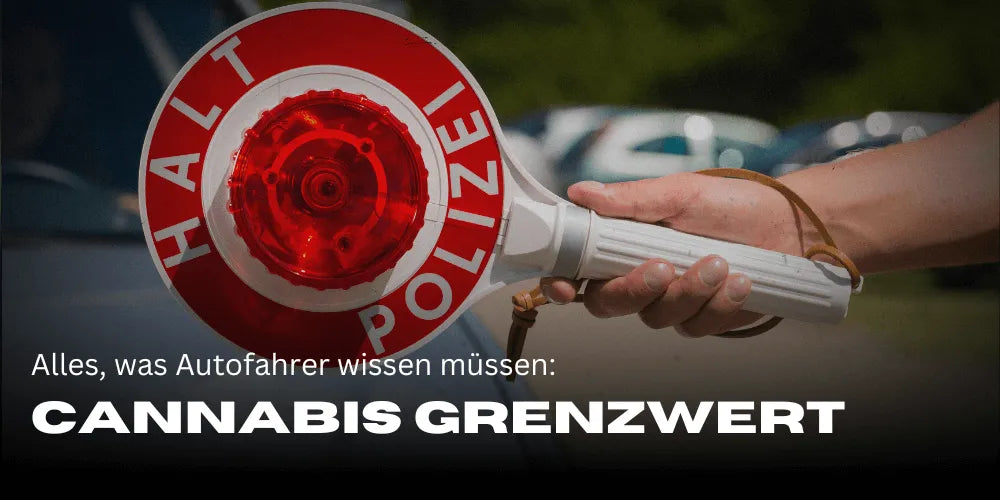


The THC limit plays a central role in this: it determines when users are considered unfit to drive. This article sheds light on how the THC limit is regulated, what the consequences are and how drivers can avoid legal problems.
What is the THC limit and why is it important?
The THC limit value indicates the concentration of THC in the blood above which a driver is considered unfit to drive. In Germany, this value is 1 nanogram per millilitre (ng/ml) of blood serum . This is comparatively low - and surprisingly strict for many consumers.
This limit is checked by the police during traffic checks using blood tests. It is based on the assumption that even small amounts of THC can impair fitness to drive. The aim is to ensure the safety of all road users, even if the value is scientifically controversial.
How is THC detected in the body?
THC can be detected in the body in various ways, whereby the method depends on the situation. In road traffic, a rapid test is often used to detect THC in saliva or urine. However, these tests only serve as an initial indication for the police, as they cannot provide precise results. A positive rapid test usually leads to a blood test in which the exact THC concentration is measured.
The authorities differentiate between active THC, which is responsible for the impairment of driving ability, and the degradation product THC-COOH. While active THC is broken down relatively quickly, THC-COOH remains stored in the body for much longer and is therefore still detected days or weeks after consumption. This long-term evidence plays a role above all in the medical-psychological examination (MPU) when it comes to obtaining a driving licence again.
Legal consequences of infringements
Anyone who exceeds the THC limit must expect severe penalties. Even after the legalisation of cannabis, road traffic remains a strict area. The possible consequences include:
- Geldbußen At least 500 euros for a first offence.
- Points in Flensburg : Two points on the driving licence register.
- Fahrverbot : At least one month without a driving licence.
- Führerscheinentzug : Regular consumption or drunk driving can lead to the loss of your driving licence.
In addition, there is the threat of lengthy procedures, such as the MPU, which requires proof that consumption and driving are consistently separated.
How long does THC stay in the body?
The length of time for which THC is detectable varies greatly and depends on several factors:
- Konsumhäufigkeit Regular users often have higher THC levels, as the active substance accumulates in fatty tissue.
- Stoffwechsel : A fast metabolism breaks down THC more quickly.
- Konsumform THC is broken down more quickly when smoked than when consumed orally, for example through edibles.
Active THC is usually only detectable in the blood for a few hours. THC-COOH, however, can be detected for days or weeks, especially if taken regularly.

THC limits in international comparison
Germany is one of the countries with particularly strict THC limits. In the USA, these values vary between 2 and 5 ng/ml depending on the state. In Canada, the limit for novice drivers is 2 ng/ml, while higher values are tolerated for experienced drivers.
The Netherlands takes a different approach: here, the focus is less on the limit value and more on the visible impairment of the driver. These more flexible approaches are also increasingly being discussed in Germany, as the current limit value does not always establish a direct link to fitness to drive.
Tips for drivers: Safe driving after legalisation
The legalisation of cannabis has eased the legal situation for users, but strict rules still apply in road traffic. Consumers should follow these tips to avoid legal problems:
- Allow sufficient time Wait at least 24 to 48 hours after consumption before driving.
- Take traffic controls seriously : Cooperative behaviour helps to avoid unnecessary stress.
- Separate consumption and driving : Even small amounts of THC can have consequences.
- Use quick tests THC tests for home use can provide a rough orientation.
If you want to be sure that you are unfit to drive, you should leave your car at home. Safety always comes first - for yourself and other road users.
Conclusion: Caution despite legalisation
Even though cannabis is now legal in Germany, the strict rules for road traffic have not changed. The THC limit remains low and even small amounts can lead to legal problems.
However, the discussion about a possible reform of the limit values remains exciting. Perhaps in future Germany will follow countries such as Canada, where not only the THC concentration but also the actual ability to drive is taken into account. Until then, responsible consumption and a clear separation of consumption and driving are the key to avoiding problems. If you want to know your score, here's the perfect product for you!


